





What is an AI accounting tool?
AI accounting tools are software solutions that use artificial intelligence to process or execute accounting and finance tasks. Typical use cases include:
- Capturing and interpreting invoices
- Account coding and creating journal entries
- Matching bank and credit card transactions
- Reconciling accounts and ledgers
- Detecting duplicates and anomalies
- Prioritising exceptions
- Producing closes and reports
These functions say relatively little about how far the automation actually extends. The relevant distinction is therefore between assistance, automation and autonomous execution.
What types of AI accounting tools are there?
1. Accounting and ERP systems with AI features
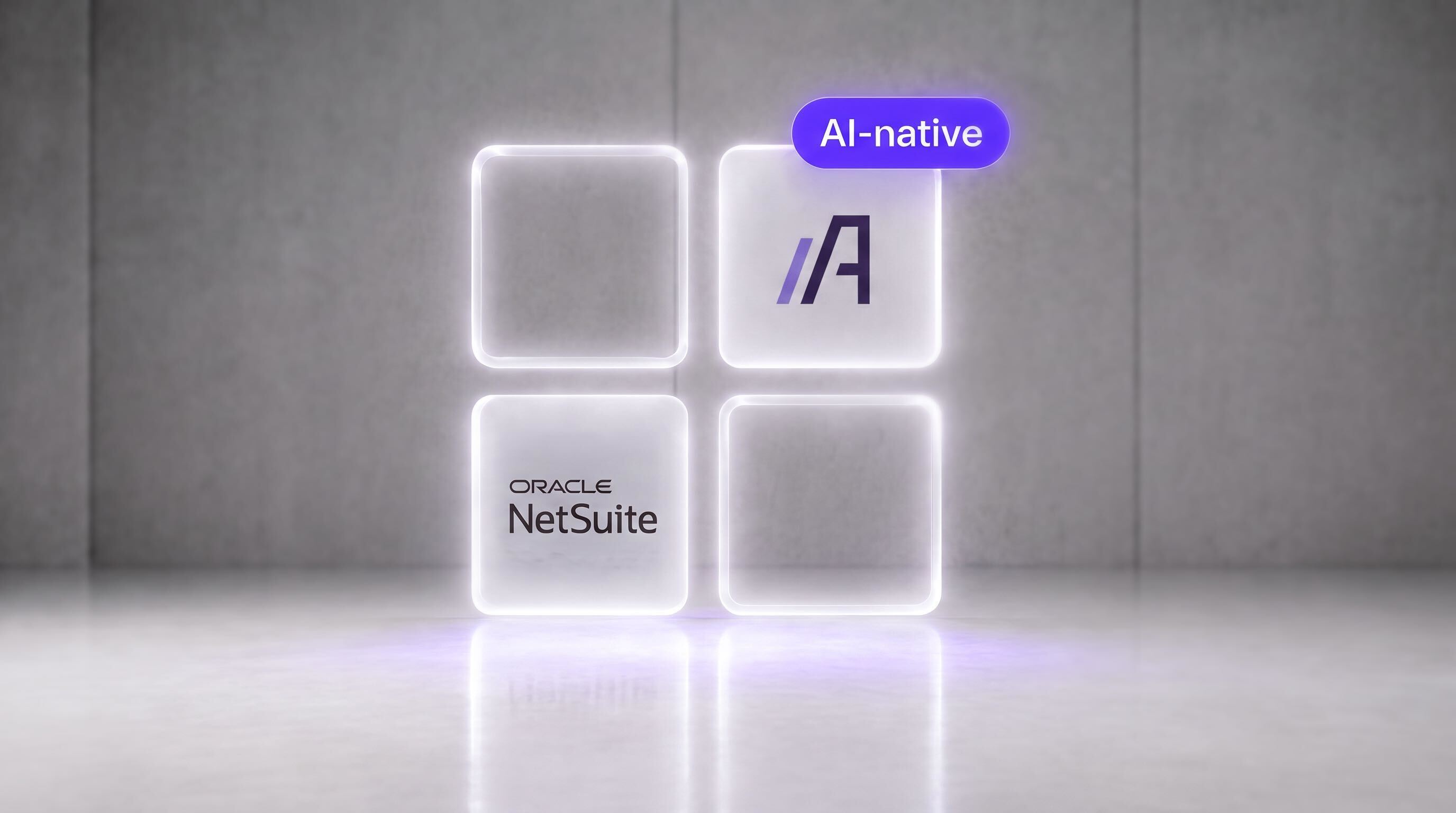
Established accounting and ERP systems are extending their existing logic with AI-enabled features. In the DACH region, these include various local and international ecosystems, for example DATEV in Germany, Abacus in the Swiss market, BMD in Austria, and ERP platforms such as SAP, Microsoft Dynamics 365 or Oracle NetSuite.
Their strength often lies in the existing system landscape, familiar processes and an established partner network. The decisive question, however, is this: does the AI change the operational core, or does it merely add individual features to the existing model, which is usually organised periodically?
2. Specialised AI tools
Specialised AI solutions focus on a clearly defined process step, such as invoice receipt, account coding, credit card postings, dunning or reconciliation. They can quickly resolve a specific bottleneck and can often be connected to an existing accounting or ERP system.
Their limit is reached where multiple point solutions create new handovers. When data, approvals, postings and controls are spread across different systems, local efficiency increases while the overall process can remain fragmented. The practical review by tax & bytes confirms this with concrete examples: even among the specialised tools examined, fixed assets, depreciation and account reconciliation remained outside the automation and continued to run manually in the system of record. Such blind spots are not an isolated case for individual providers, but a structural consequence of the fact that a tool only ever automates the segment it was built for.
3. Finance copilots
A finance copilot is an AI-enabled assistant that simplifies access to financial information, answers questions, summarises developments and supports analysis. The term here refers to a general system category, not Microsoft Copilot. This allows finance teams to find, interpret and use information for decisions more quickly.
However, a copilot is not automatically an executing system. It can explain which invoices are overdue without executing dunning itself. Equally, it can identify a discrepancy without processing it within a controlled workflow. What matters for the assessment, therefore, is whether the AI merely provides information or also takes on operational responsibility within clearly defined limits.
4. AI-native finance platforms
AI-native platforms are built from the ground up for agentic execution. Data model, workflows, controls and AI form a shared operational core. Specialised agents take on defined tasks, document their decisions and escalate cases that require human judgement. The real leap compared with the first three categories is the shift from point automation to agentic, autonomous execution of entire finance processes.
The Aderis Live Finance Platform belongs to this category. It does not simply connect individual accounting functions; it continuously executes finance processes across entities, ledgers and currencies.
AI accounting tools: the categories compared
A direct comparison of the four categories across eight criteria: from basic AI enhancements in ERP systems to AI-native finance platforms that execute financial processes autonomously.
Why AI-native and AI-enabled are not the same thing
AI-enabled software adds AI functionality to an existing system retrospectively. It can make information accessible more quickly and improve individual work steps. However, the underlying data models, system boundaries and periodic processes often remain unchanged.
On an AI-native platform, data, workflows, controls and AI form a shared operating model. Within the same system logic, the AI can understand information, apply rules, execute tasks, document outcomes and escalate exceptions. It is precisely this shared architecture of data, workflows and controls that explains why the number of individual AI features says less than how deeply they are embedded in the system.
McKinsey describes agentic AI as an occasion to fundamentally redesign task flows, human roles and processes. Organisations that simply layer agents onto existing workflows may end up automating the fractures in the old model. McKinsey's analysis of the future of ERP systems likewise shows that AI does not just add extra features, but changes the architecture and use of core enterprise systems. Gartner also stresses that governance and control architecture must be resolved before AI agents are scaled, not afterwards.
When are AI add-ons no longer enough?
The limit becomes visible once finance needs to do more than simply speed up individual accounting tasks: it must continuously run a more complex business.
1. Multiple entities, ledgers and currencies
Every additional entity brings its own chart of accounts, intercompany relationships, approvals and closing requirements. When these structures are connected through separate instances and spreadsheets, the reconciliation workload often grows faster than the business itself.
2. Fragmented end-to-end processes
Very good invoice recognition does not by itself automate Purchase to Pay. Purchase order, proof of delivery, approval, payment, bank reconciliation and reporting can still take place in separate systems. The quality of a single step should not, therefore, be mistaken for automation of the process as a whole.
3. Financial data remains backward-looking
When the bank, sub-ledgers, general ledger and upstream systems are only brought together at month-end, finance continues to operate periodically. AI may then speed up the processing, but it does not remove the structural delay. The real shift is from a periodic month-end close to a continuous closing process that keeps finance current all year round.
4. Controls sit outside execution
As soon as AI executes transactions or processes, permissions, segregation of duties, approvals, thresholds and exception paths must be embedded in the system. Downstream controls can identify errors after the fact. Embedded controls prevent, limit or escalate them during execution.
5. Growth creates proportionally more manual work
A scalable finance model must be able to absorb additional transactions and complexity without headcount needs rising proportionally. If data transfer, reconciliation and exception handling remain manual, the software scales but the finance process does not. This, in Aderis's view, is the benchmark finance teams should grow against: without proportional increases in headcount.
What Aderis does differently from conventional AI accounting tools
Aderis is an AI-native Live Finance Platform for growing businesses in Switzerland and Europe, with offices in Switzerland, Germany and Austria. On its AI-native core, accounting runs autonomously and every figure remains traceable to its source. The open architecture orchestrates the finance cycle across entities, ledgers and currencies.
The difference lies in the depth of execution. Aderis does not just generate posting suggestions and hand them off to the next manual step. The platform executes defined finance processes within a shared data, control and permissions model. As a result, finance is not reconstructed only at month-end; it stays current throughout ongoing business, because agents move automation step by step into autonomous execution, rather than simply speeding up individual tasks.
The architecture consists of three layers:
- The Platform Engine forms the AI-native core. AI agents, automation, integrations and APIs, controls and compliance, and centralised operation across multiple entities, ledgers and currencies are all embedded at this layer.
- Core Finance executes the central processes: Order to Cash, Purchase to Pay, Record to Report and Treasury. A dedicated agent layer carries out tasks across these processes and escalates exceptions to the finance team.
- Advanced extends the platform on a modular basis with Payroll, Workforce, Financial Planning and Analysis (FP&A), BI reporting and the digitisation of paper documents (e-Post).
.jpg)
Specialised agents take on clearly defined tasks under rules and permissions. They document execution and escalate exceptions for human review. Aderis does not need to replace every local specialist system in the process. The open architecture can integrate existing systems where they continue to serve the right function. The decisive difference is that financial reality is not reassembled after the fact from separate systems, but comes together within a continuous operating model.
Eight questions for selecting an AI accounting tool
Before making a decision, CFOs and finance teams should ask providers for concrete, verifiable answers to the following:
- Which process steps does the system execute itself, and which does it merely prepare?
- What data does the AI work on, and how current is that data?
- How does the system detect and handle uncertainty, exceptions and conflicting information?
- Can every figure be traced back to the original document, the transaction and the decision behind it?
- Where are roles, permissions, segregation of duties and approvals technically embedded?
- How are multiple entities, ledgers, charts of accounts and currencies managed?
- Which interfaces are standardised, and where do manual file exports remain necessary?
- Which operational metrics will be used to measure the benefit after 90 and 180 days?
Conclusion: the best tool solves the right problem
An established accounting or ERP system with AI features can be sufficient for standardised processes. A specialist tool can effectively remove a specific bottleneck. A copilot can make financial information accessible more quickly. These solutions, however, reach their limits once finance needs to operate continuously across multiple entities, systems and currencies.
At that point, the accuracy of a single posting suggestion is no longer enough on its own. What matters is whether the platform executes finance processes end to end, embeds controls in the workflow, and keeps every figure traceable to its source: the shift from periodic accounting to continuous finance execution. A good AI accounting tool reliably executes standard cases, makes uncertainty visible, and gives finance control precisely where specialist judgement is required.