





- From task to process: Agentic AI does not just automate individual work steps; it executes multi-step finance processes within defined rules and permissions.
- Control within execution: The finance team defines permissions, thresholds, approvals and escalation paths. Agents execute routine processes and make exceptions visible earlier.
- From answer to execution: Ada, the Aderis finance agent, answers CFO questions on the basis of current financial data and can execute the resulting process steps under control
AI systems in finance are evolving from analytical tools and digital assistants into agents that execute multi-step processes largely autonomously, within defined rules and permissions. Live Finance is the operating model that supports this shift: financial data remains continuously current, controlled and traceable to its source, while agents execute routine processes continuously and escalate exceptions for human review.
CFOs assign the topic a high strategic priority, yet practical implementation in many organisations remains at a low level of maturity. What matters is an AI-native data and system architecture in which financial data is captured, structured and updated continuously in its business context. Agents can understand relationships reliably, act on that basis and escalate exceptions in a targeted way only when financial data and process information reflect the current state of the organisation.
An AI layer added retrospectively cannot compensate for a delayed or incomplete data foundation. Architecture is decisive. Automated decisions must also remain controllable, postings traceable and interventions documented; accountability continues to rest with the company and its governing bodies. This article assesses the current state of development and sets out the requirements for data, systems, permissions and traceability that must be met for Live Finance with agentic AI to be traceable, reliable and economically viable.
Why is agentic AI relevant for finance?
Artificial intelligence has moved beyond the pilot stage in finance. Large language models answer questions, analyse variances and draft reports. Agentic systems go a decisive step further: they translate an objective into individual work steps, access systems through interfaces, check results and execute processes autonomously within defined rules. They escalate to a person only when an exception arises or a defined threshold is reached.
Few business functions offer more potential for this than finance. A large share of the work follows clear rules, recurring processes and structured data. At the same time the requirements are particularly demanding, because postings, closes and regulatory filings must be accurate, auditable and traceable at all times. The central question is therefore not whether agentic AI can change finance processes, but under what conditions it does so with control, traceability and economic value.
What is agentic AI in finance? Definition and stages of development
Agentic AI describes systems that plan autonomously towards an objective, use tools, access systems and evaluate results. This sets them apart from analytical models, which produce forecasts, and from generative assistants, which support individual tasks on request. For Live Finance, however, this capability is not sufficient. The agent must understand current, structured financial data in its business context and be able to act on it within clearly defined permissions.
This requires an API-first architecture in which validation, authentication and approval rules take effect directly within the system. As the scope for autonomous action grows, the role of people shifts from execution to governing rules, exceptions and decisions. Only the combination of continuously current data, operational execution and embedded control turns agentic AI into Live Finance.
These stages build on one another, but they are not an automatic maturity curve. An organisation can deploy an AI assistant and still operate periodic, fragmented finance processes. Live Finance, by contrast, begins where current data, executable processes and embedded controls come together. Only then does agentic functionality become a robust finance operating model.
How mature is agentic AI in the finance function today?
AI has become a clear priority in the finance function. In one survey, 88% of CFOs described it as essential or important to their finance agenda. Around 96% expect AI to change their function significantly or fundamentally within the next five years. Leading finance organisations that already deploy AI at scale report a realised return of more than 25%. In practice, however, assistants and point automation still dominate. Organisations achieve the greater economic effect where they redesign their finance processes end to end and run them on a continuously current data foundation.
A documented Live Finance deployment in retail shows how far this impact can reach. After the move to Live Finance, 95% of incoming payments were matched automatically. The soft close was reduced from 15 days to three, while the workload associated with dunning decreased by 70%. In total, the finance team regains around 50 working days per year. For the CFO this means more than lower process costs: liquidity and overdue receivables become visible earlier, the close is completed sooner, and finance professionals gain time for performance management and decisions.
What measurable impact does Live Finance deliver in practice?
The continuously current data foundation also opens up possibilities that go beyond conventional automation. At the company mentioned above, the management team wanted to know at short notice what the monthly cost per employee was. No such report had been prepared. The Live Finance agent produced the analysis from the existing data within seconds. No figures had to be consolidated manually and no new report had to be built. The decisive advance therefore lies not in speed alone: Live Finance can respond to new questions as they arise.
This is where the boundary between point automation and Live Finance lies. An additional AI interface on an existing accounting system can make information easier to access. It does not, however, create end-to-end financial execution. That requires processes and ways of working to be redesigned end to end and data, controls and the system of record to be considered together. Live Finance is therefore not another AI layer but a new operating model: financial data remains current, structured and available in its business context. On this basis, agents can produce analysis and execute processes within defined permissions.
Where is agentic AI applied in finance?
The potential of agentic AI extends across the entire finance function. The most significant effects usually arise in high-volume transactional processes with clear rules, while the greatest strategic impact probably lies in planning and performance management. Live Finance connects both sides: transactional execution keeps the data foundation continuously current, and it is precisely this timeliness that increases the value of forecasts, liquidity management and management decisions.
1. Finance Operations: from document to a continuously current ledger: in Purchase to Pay and Order to Cash, agents can capture documents, apply account coding, match them, prepare payment runs and track receivables. Clear rules and high volumes make these processes obvious candidates. In the Live Finance model, the benefit does not end with fewer manual clicks. Every transaction processed updates the financial picture; open items, cash position and variances therefore become decision-ready during the month.
2. General ledger and close: reconciliations, accruals, intercompany postings and checks are traditionally bundled at period end. A Continuous Close, enabled by Live Finance, moves this work into the daily routine. The month-end close does not disappear, but it loses its exceptional character: transactions, controls and evidence are already largely processed by the time the period ends.
3. Treasury and performance management: decisions on a current basis: treasury, forecasting and business performance management carry the highest strategic leverage, because they influence capital allocation and operational decisions. Their value depends directly on how current the underlying data is. When banks, entities, ledgers and currencies are continuously synchronised, finance can manage liquidity, margins and variances on the basis of today's position, rather than on the basis of a month-end view consolidated later.
What are the requirements for agentic AI in finance?
Finance is subject to higher requirements than many other areas of application. Results must not only be produced efficiently, they must also be accurate, controllable and auditable. These requirements do not change when an agent takes over the work. Live Finance increases the cadence, and with it the importance of an architecture that does not add control retrospectively but builds it into every execution.
1. Data quality, timeliness and provenance
Finance is accountable for the organisation's consistent set of figures. Agents must not change source data or calculation logic in an uncontrolled way. At the same time, historical posting logic alone is not enough. Debit, credit and VAT may be sufficient for a close, but they give an agent too little context to act reliably. Live Finance therefore requires continuously updated, structured and source-linked data, together with documented data provenance.
2. Control and segregation of duties
Agents need clearly defined roles, permissions and approval limits. Segregation of duties must be reflected directly in the system design. Interpretative AI and deterministic accounting logic should remain separate: the agent can classify, match and prepare; rules, approvals and posting logic limit what is actually executed. People retain judgement, approval authority and accountability.
3. Traceability and auditabilityEvery material decision must be documented and traceable back to its source. This includes who acted, which rule applied and which data the result is based on. In Live Finance, the audit trail moves from retrospective evidence to a continuous part of the process. Every figure remains linked to its source, workflow and approval. This is what allows continuous execution to scale in an audited environment.
4. AI-native and API-first architecture
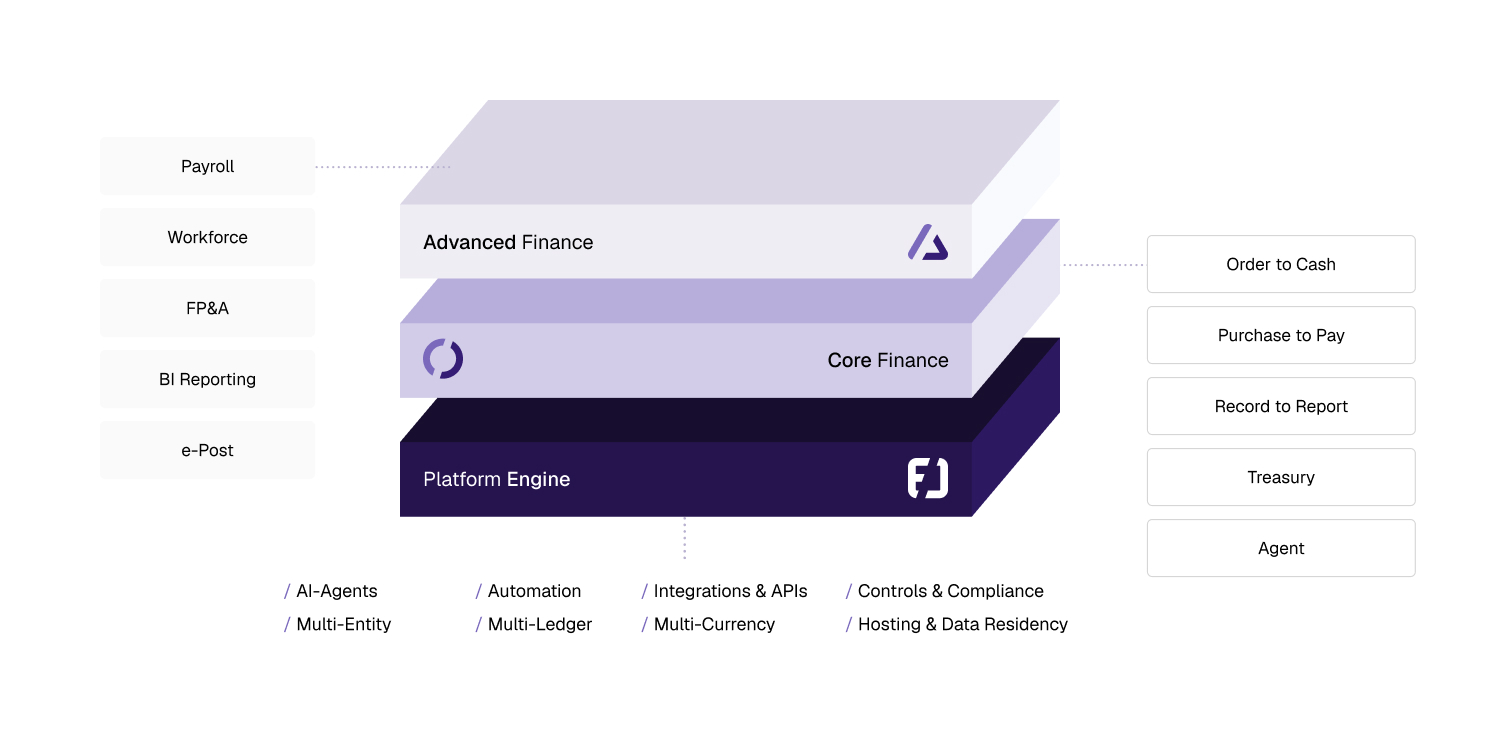
An AI layer added retrospectively can simplify queries and flag anomalies. It changes neither the update rhythm nor the data structure of the core system. For Live Finance, the agent must be able to act at system level: through APIs, with full authentication, validation and role-based permissions governed by the same control framework as human users. AI-native therefore describes an architecture, not an additional product feature or AI add-on.
5. Trust and new roles
Trust does not come from maximum autonomy but from traceable results and clear opportunities to intervene. Finance teams must be able to see how a result came about and when their judgement is required. With Live Finance, the scope of work shifts from routine tasks, data capture and periodic reconciliation towards setting rules, handling exceptions and supporting decisions. People do not disappear from the process; they work where context and accountability matter.
What is Live Finance? A new category in finance
Live Finance is neither a faster dashboard nor a new name for automation. The category describes an AI-native finance operating model in which accounting, controls, reporting and treasury work on a continuously updated financial reality. Documents are captured on receipt, transactions are account-coded continuously, bank transactions are reconciled on an ongoing basis and controls are executed within the workflow. The close remains, but it becomes the result of a system in a continuous state of close readiness rather than a monthly reconstruction of the past.
The distinction from AI-enabled finance is essential. An agent on a legacy ERP system can summarise content, answer questions or find errors. As long as the core system works in batches, holds data in fragments and actions take place outside its control logic, finance continues to operate periodically. Live Finance therefore places agentic AI in the operational core: insight becomes execution, and a retrospective report becomes a continuous financial state.
How do you move from a legacy system to Live Finance?
The move does not begin with an agentic pilot operating on legacy data, but with the system of record. Chart of accounts, master data, opening balances and historical postings are migrated into a structured, source-linked data foundation. Banks, payroll, billing and operational systems are connected through APIs. Only once opening positions are reconciled and permissions are set does the Live Finance Platform take over day-to-day accounting.
Data migration is not a downstream technical task but part of the new Live Finance operating model. Historical postings, master data and mappings must not only be transferred but converted into a consistent structure. In documented Live Finance implementations, this covered seven to eight years of financial history. Scope, quality and the number of source systems determine how demanding this step is. The first benefit arises with the cleaned data foundation itself: historical and current financial data can be analysed together and processed by agents in their business context.
What changes with Live Finance and agentic AI?
An accountant in a Live Finance customer onboarding used the agent immediately after data migration to orient themselves in the new system. Questions that would otherwise have required manuals, support or system knowledge were answered in the context of the actual financial data. The example shows the difference between a chatbot alongside the system and an agent that knows the system, its data and its rules.
The category is particularly relevant for growing organisations where complexity increases faster than the finance function: multiple entities, countries, currencies, ledgers, banks and regulatory requirements. Here the value comes not from a single automation but from a shared, continuously current financial reality.
What does this mean for CFOs?
Agentic AI can be deployed productively in finance. The documented effects are substantial, yet models alone create no value. What matters more is redesigned processes, a robust data and system architecture, and governance that extends the agents' scope for action in a controlled way. Live Finance brings these requirements together into a category of its own. It describes the move from periodic accounting to a continuously operating, AI-native finance function in which data, execution and control work on the same current basis.
Traceability is not an obstacle to automation. It is the precondition for scaling agentically executed processes in a regulated and audited environment. Every material decision must remain controllable, documented and traceable back to the data it is based on. The same applies to timeliness: an agent can act only on what the system knows, in structured and controlled form, at that moment. Without continuously current data, agentic AI in finance remains an assistant operating on the past.
For finance leaders this creates a dual mandate: they must automate high-volume transactional processes in the short term while building the data, system and control foundations for greater autonomy. The real decision, however, is architectural: will the existing system continue to be retrofitted, or will finance move to an operating model built for current data and agentic execution? Live Finance and agentic AI make this alternative visible and therefore strategically decidable.
The finance function therefore shifts from producing and reconciling figures to governing processes, exceptions and decisions. Fundamentally, this is about integrating finance back into the business. The figure is then no longer the delayed output of a closing process but a continuously available, controlled part of how the company is run.