





- From tasks to processes: agentic AI shifts automation from individual finance tasks to the autonomous but controlled execution of entire finance processes.
- Governance instead of routine: finance teams set permissions, thresholds and escalation rules rather than spending their time reviewing and executing routine work.
- Answer plus execution: "Ada", the Aderis finance agent, shows what this looks like in practice. A CFO question such as "which finance tasks are urgent today?" does not end with a list, but leads straight to the next step in the process.
What passes for modern in many finance teams today is often just a more efficient version of an old operating model. Simple automations do reduce manual effort, but at their core the processes remain periodic, rule-based and stitched together by numerous human handovers. The shift now under way in the age of AI reaches considerably deeper: agentic finance agents work through multi-step sequences such as invoice processing, account reconciliation or dunning within defined rules and approvals, check the results and escalate exceptions. Automation in the finance function thereby moves from individual tasks to the autonomous, but controlled, execution of entire finance processes.
For CFOs, the strategic value therefore lies not in greater efficiency alone, but in a changed basis for decisions. Instead of waiting for the next close, they can draw on figures that are current, controlled and traceable. Finance develops from a backward-looking reporting function into an operational layer that moves with the growth of the business.
What does agentic AI in finance actually mean?
Many finance departments already automate individual steps: software reads data from invoices, bots transfer it between systems, and rule sets assign it to the appropriate accounts. These systems follow predefined sequences and stop as soon as a case deviates from the expected pattern.
Agentic AI moves automation from the individual task to the overarching goal. Where an invoice needs to be posted correctly or a payment run prepared, an agent coordinates the necessary steps: reading documents, matching master data, assigning accounts, running controls and identifying exceptions. Throughout, the agent acts within defined permissions and approvals. A chain of separate systems and manual handovers becomes one continuous finance process. The decisive difference lies not in a chat interface, but in whether AI merely supplies information or is embedded in operational execution.
"Ask Ada": from the CFO's question to execution
Most CFO questions concern the company's current financial position: "Consolidate today's figures for all entities in CHF." "Which overdue receivables need attention today?" "What is holding up the close?" These are not pure reporting questions. The answers depend on transactions, documents, reconciliations, approvals and controls. In traditional finance environments, that information is usually spread across the ERP, accounting software, banking tools, spreadsheets and reporting systems.
This is precisely where "Ada" comes in, the conversational finance agent of the Aderis Live Finance Platform. Behind it sits an AI-native core that brings accounting, controls, reporting and treasury together in a continuously updated financial context. That context spans multiple entities, ledgers and currencies. The CFO therefore does not have to reassemble the data foundation before every question. The context is already there, and the agents can execute multi-step finance processes within defined permissions and approvals, and document them so they remain fully traceable.
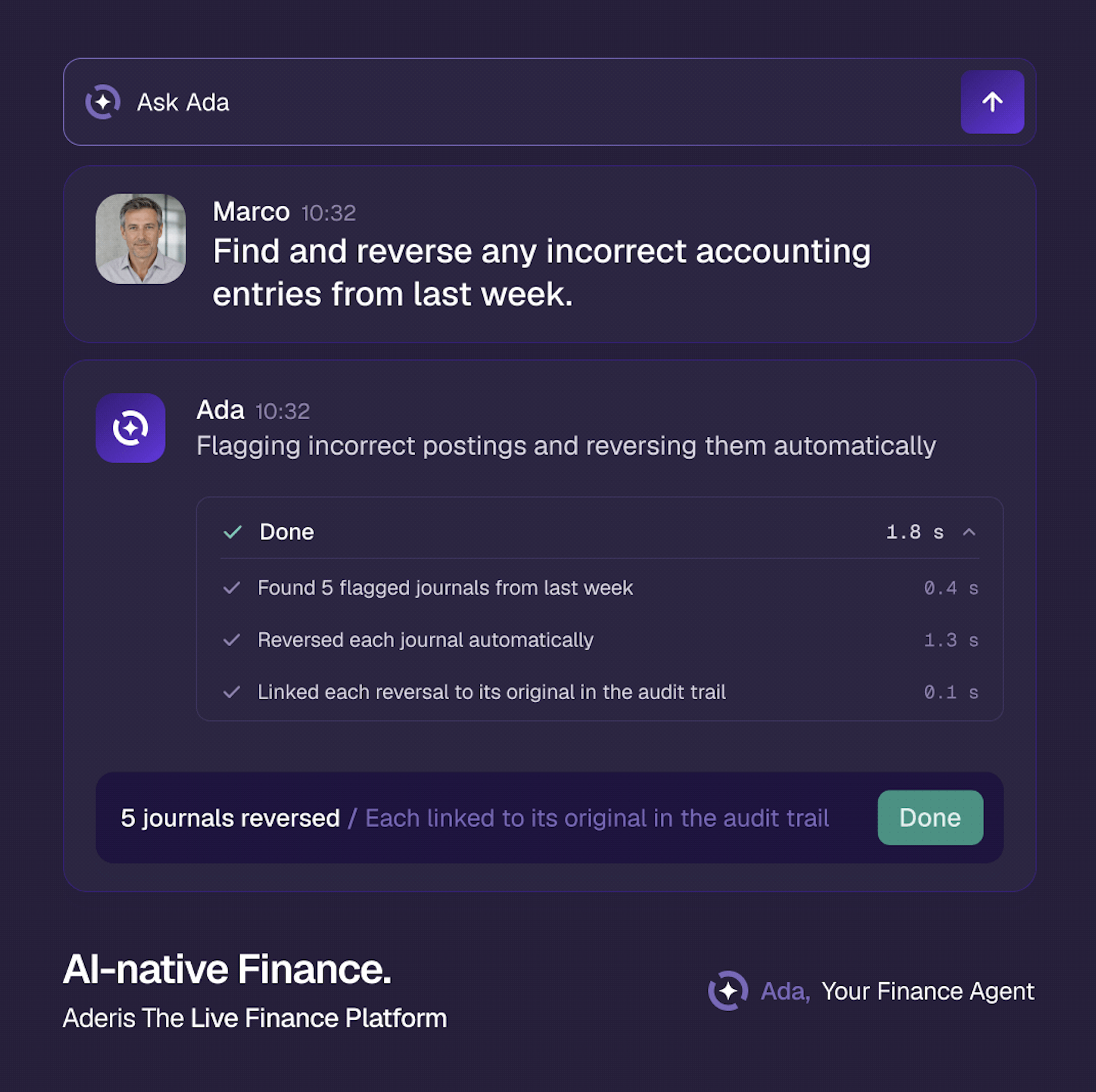
The real difference shows where conventional analysis ends. Asked "which overdue receivables need attention today?", an analytics tool returns a list. The finance agent "Ada" can carry the process forward: identify the relevant receivables, surface exceptions, and route decisions to the people whose approval or professional judgment is required. A conventional system supplies information. "Ada" connects the answer to controlled execution. That is the difference between a chat interface over financial data and an AI that is embedded in operational execution.
Where are AI agents used in finance today?
Structured finance processes with high transaction volumes are the strongest fit. These include capturing, coding and posting incoming invoices, preparing payment and dunning runs, reconciling bank transactions, and producing recurring reports.
Finance agents are increasingly used in more complex sequences as well. In a multi-ledger architecture, a single transaction can be processed according to different statutory, tax and intercompany requirements. In forecasting and reporting, agents can identify variances and prepare initial explanations before the finance team validates assumptions and results. The decisive advance is not speed alone. The working principle changes: people no longer produce every individual process step themselves, but define controls, handle exceptions and review the results.
Human in the loop: how do CFOs stay in control of AI agents?
In an agentic finance system, control does not mean approving every step by hand. It begins with defining what an agent may execute on its own and where it has to stop. Two business partners with the same tax number, an amount above the approval limit, or a missing account assignment are not cases for assumptions. A reliable finance agent halts the process, documents the deviation and escalates it, with the relevant context, to the responsible person.
For CFOs, control therefore shifts from reviewing individual transactions to governing the system as a whole. They set permissions, approval limits and escalation paths. Every action remains traceable to its source, the rule set applied and the corresponding approval. The agents take over execution. People define the scope for action and retain responsibility.
How relevant are AI agents for CFOs?
Every software category eventually reaches the point where its central assumption no longer holds. For traditional ERP systems that assumption was: financial data is captured periodically, processed in batches and reviewed by people. Agentic AI calls that model into question. Not because AI happens to be in fashion, but because AI-native architecture is what makes continuous, structured financial data possible in the first place.
CFOs who see this as a mere interface update will automate individual tasks without changing the operating model of the finance function. Those who understand the shift as a question of infrastructure can reorganise finance: with continuous execution, traceable controls, and human judgment where it is required.
The decisive question is therefore no longer how much AI sits inside an ERP. It is whether finance carries on explaining the past, or starts working live with the business.