


The essentials
- AI-native is built as an architecture from the ground up, not an add-on AI feature.
- General accounting moves to real-time. Planning and forecasting become dynamic.
- The role of finance professionals is shifting from execution to oversight.
AI-native has become a common label across enterprise software. ERP vendors, accounting platforms and software providers all describe their products as AI-native. As the label has spread, its meaning has become less precise. AI-native and AI-powered or AI-enabled are not synonyms.
One way to understand the AI-native shift in finance is to recognize that it is not simply about adding AI to existing financial processes. Instead, it represents a fundamental change in how finance departments in organizations operate. Rather than treating AI as another productivity tool, the AI-native shift is built around a shared intelligence layer that understands business context, policies, historical decisions, and operational knowledge. This changes the role of traditional systems.
Explaining the shift
Traditional automation is primarily rule-based. For example, an approval workflow might be defined as:
If an invoice exceeds CHF 5’000, route it to a manager for approval.
The system does not understand why the approval is required. It simply executes a predefined rule.
An AI-native approach is fundamentally different because it operates on organizational knowledge, not just predefined workflows. Instead of relying only on static rules, the AI has access to information such as:
- Accounting policies
- Customer and supplier contracts
- Historical supplier relationships
- Cost center structures
- Internal approval policies
- Previous financial decisions
Because these sources are connected, AI can reason over financial context, recommend actions, and automate parts of decision-making while keeping humans involved for oversight and judgment. For example, instead of applying a fixed rule, it could explain:
"This invoice should be allocated to Cost Center X because it relates to Contract Y, follows the company's accounting policy for software subscriptions, and is consistent with how comparable invoices from this supplier have been classified in the past."
This illustrates the core difference between workflow automation and knowledge automation.
From traditional to AI-native finance
What AI-native finance does not mean
Being AI-native does not mean “having AI features”. It’s common today to integrate AI functions into existing workflows. These include, for example, summarizing reports or detecting anomalies in transaction data. These functions can be useful. However, they do not automatically change the architecture.
A batch-based ERP with an AI layer on top remains a batch-based ERP. The AI simply analyzes the data it has access to. In a batch ERP, that means the most recent data run. If that run took place last night, the AI works with yesterday's data. If the period hasn’t been closed yet, it works with last month’s data. That’s not AI-native. It’s so called AI-enhanced, AI-powered, or AI-enabled or in other words: AI as an add-on.
What AI-native finance looks like in practice
Latest research outlines five domains where the shift is most advanced:
- General accounting moves to real time: Accounting processes become increasingly continuous, with AI agents assisting with reconciliation, classification, and review.
- Reporting becomes fully automated: The dashboards are updated in real time, while interactive interfaces provide detailed insights into individual metrics.
- Planning and forecasting become dynamic: Models are continuously updated as new data comes in and simulate scenarios related to capital allocation, pricing, demand, and liquidity. Deviations are automatically explained, while agents recommend corrective actions.
- Transaction operations transition to full autonomy: Transaction operations become increasingly agent-assisted, with AI handling repetitive processes and humans in the loop.
- Expert functions like treasury, tax, risk are supported by AI: Agents monitor liquidity positions, hedging exposure, and regulatory shifts continuously, surfacing opportunities that static models miss.
Why AI-native architecture outperforms AI add-ons
In the early years, AI-enabled systems can deliver earlier results because they are simpler to deploy. But as operational complexity increases; more entities, more transactions, more exceptions; they plateau. AI-native architecture, on the other hand, improves with every document processed, every transaction encoded, and every anomaly detected. The gap between the two curves is the result of architectural compounding.
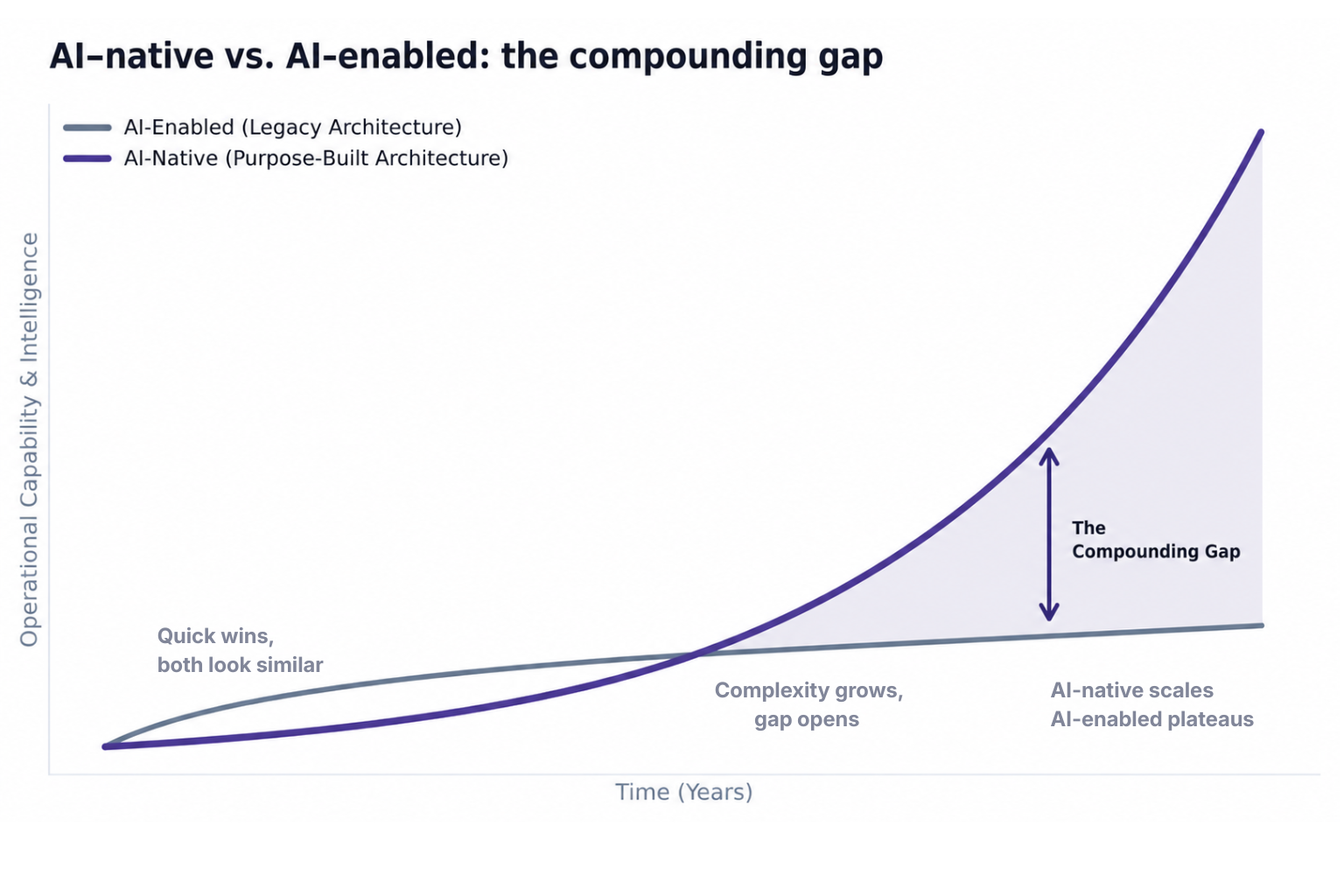
AI in finance will continue to improve. Models will become more powerful, user interfaces more intuitive, and workflows more comprehensive. However, the upper limit of what AI-native solutions in finance can achieve is determined by the timeliness, structure, and quality of the data they access.
Live Finance raises this upper limit. An outdated batch-based system with AI as an add-on limits it. Regardless of how powerful the integrated AI layer is.
What comes next
The next era of financial services will belong to institutions that operate in real time, adapt instantly, and make decisions faster than legacy systems can process data. From human-driven workflows to agent-orchestrated outcomes with human oversight. The organizations that treat AI as a feature to be added on will inevitably lag behind those that treat AI as a native operating model.


